
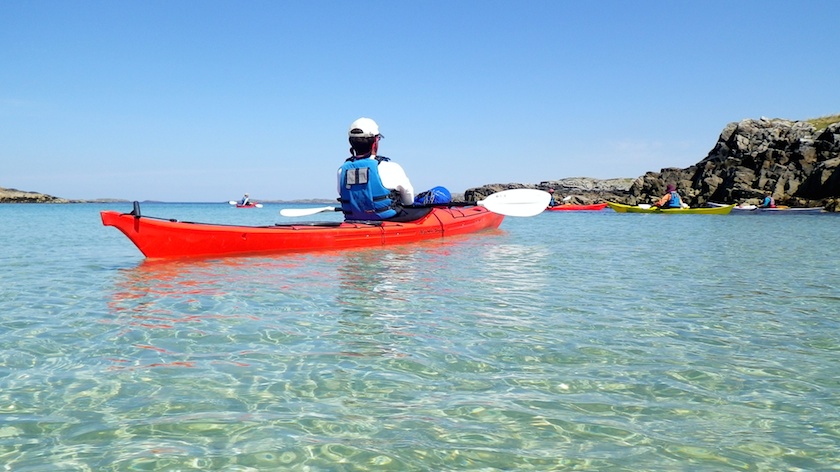
 Today we are very lucky to have sea kayaking legend Justine Curgenven from Cackle TV offering advice for anyone considering an expedition by sea kayak. As well as having kayaked around Kamchatka, Tasmania, Tierra del Fuego and Wales (and across the English Channel with me vomiting from a nearby boat) amongst other places, Justine is the pre-eminent sea kayaking film-maker and the brains/camera behind the award-winning ‘This Is The Sea’ DVD series. Over to Justine…
1. Start small and work your way up. If you’ve never been on a sea kayaking expedition, go for an overnight trip close to home. If you have forgotten a lighter to start your stove or some other vital piece of kit, it’s not a disaster. Work up to going away for a few days and you’ll learn what you need to take by trial and error.
2. Pack small. You can fit about 2 rucksacks full of kit into a typical expedition sea kayak. This might sound like a lot but the space soon disappears when you start packing. Try to only take what you need – put toiletries in small bottles, remove unnecessary food wrapping, consider taking small camping equipment – for example a thermarest or Exped matt rather than a bulky carrymat, & limit your clothing to the essentials. It’s much easier to pack your things into lots of small drybags than to pack it in a few big drybags. Its also easier to find things if they are in smaller, colour coded bags. I carry a bag for my clothes, a bag for breakfast food, 1 for lunch food, 1 for dinner food, 1 for drinks, 1 for my sleeping bag, 1 for my Exped matt, 1 for my half of the tent etc.
3. Keep a set of warm clothes for land use only. Never wear these at sea, no matter how painful it is to put your wet, smelly thermals back on in the morning. When you land after a long damp day, you need to have some dry clothes to change into.
4. A barometer on your watch is very useful. When you stay at sea level then changes in the pressure can warn you about changes in the weather. As a general rule, a sudden change (down or up) usually means strong winds are coming. I have a Casio trekfinder watch which shows a graph of the pressure changes over the last 24 hours which I find really useful.
5. It’s obvious but you’ll need a kayak. It’s possible – but expensive – to ship your own kayak anywhere in the world. If you don’t want to spend a fortune then research places where you can hire or borrow kayaks, or chose somewhere you can drive to. If renting, check that the kayaks available have enough storage space, are in good condition & suitable for your needs.
Read more on https://thenextchallenge.org/10-tips-sea-kayaking-expedition/

No comments:
Post a Comment